Portal:Ruta del Spondylus: Difference between revisions
No edit summary |
No edit summary |
||
| Line 13: | Line 13: | ||
<div style="font-family:Arial,sans-serif; font-size:0.95em; color:rgba(255,255,255,0.72); max-width:600px; margin-bottom:24px; line-height:1.6;"><translate>The coastal highway north of the peninsula — a succession of surf breaks, fishing coves, cloud-forest headlands, and some of the most beautiful beaches in Ecuador, running toward Manabí.</translate></div> | <div style="font-family:Arial,sans-serif; font-size:0.95em; color:rgba(255,255,255,0.72); max-width:600px; margin-bottom:24px; line-height:1.6;"><translate>The coastal highway north of the peninsula — a succession of surf breaks, fishing coves, cloud-forest headlands, and some of the most beautiful beaches in Ecuador, running toward Manabí.</translate></div> | ||
<div style="font-family:Arial,sans-serif; font-size:1.02em; color:#7dd3f0; font-weight:bold; margin-bottom:18px;"><translate>Welcome! One legendary coastal road, a dozen towns, and some of Ecuador’s best beaches — here’s how to explore all of it. 🏄</translate></div> | |||
<div style="font-family:Arial,sans-serif; font-size:0.82em; letter-spacing:0.5px; color:rgba(255,255,255,0.85); border-top:1px solid rgba(255,255,255,0.15); padding-top:16px; margin-top:2px; line-height:2;"><translate>[[#Towns of the Route|The Towns]] · [[#Live Beach Cams|Beach Cams]] · [[#Geography & Landscape|Geography]] · [[#The Spondylus Shell|Spondylus]] · [[#Nature & Ecology|Nature]] · [[#Outdoor Activities|Activities]] · [[#Getting There & Around|Getting Around]]</translate></div> | |||
{| style="border-top:1px solid rgba(255,255,255,0.15); padding-top:18px; margin-top:4px; width:100%; border-collapse:collapse;" | {| style="border-top:1px solid rgba(255,255,255,0.15); padding-top:18px; margin-top:4px; width:100%; border-collapse:collapse;" | ||
| Line 390: | Line 394: | ||
<!-- Water --> | <!-- Water --> | ||
{| class="wikitable mw-collapsible mw-collapsed" style="width:100%; border-collapse:collapse; font-family:Arial,sans-serif; font-size:0.87em; margin-bottom:14px; border:1px solid #d0dce8;" | |||
|+ style="text-align:left; font-weight:bold; font-size:1.15em; color:#003d5c; padding:8px 10px; background:#eef4f9; border:1px solid #d0dce8;" | 🌊 <translate>Water</translate> | |||
! style="text-align:left; padding:5px 10px 5px 0; color:#7a7a7a; font-weight:normal; border-bottom:1px solid #e8f5ef; width:30%;" | <translate>Activity</translate> | ! style="text-align:left; padding:5px 10px 5px 0; color:#7a7a7a; font-weight:normal; border-bottom:1px solid #e8f5ef; width:30%;" | <translate>Activity</translate> | ||
! style="text-align:left; padding:5px 0; color:#7a7a7a; font-weight:normal; border-bottom:1px solid #e8f5ef;" | <translate>Where on the route</translate> | ! style="text-align:left; padding:5px 0; color:#7a7a7a; font-weight:normal; border-bottom:1px solid #e8f5ef;" | <translate>Where on the route</translate> | ||
| Line 433: | Line 437: | ||
<!-- Land --> | <!-- Land --> | ||
{| class="wikitable mw-collapsible mw-collapsed" style="width:100%; border-collapse:collapse; font-family:Arial,sans-serif; font-size:0.87em; margin-bottom:14px; border:1px solid #d0dce8;" | |||
|+ style="text-align:left; font-weight:bold; font-size:1.15em; color:#003d5c; padding:8px 10px; background:#eef4f9; border:1px solid #d0dce8;" | 🏃 <translate>Land</translate> | |||
! style="text-align:left; padding:5px 10px 5px 0; color:#7a7a7a; font-weight:normal; border-bottom:1px solid #e8f5ef; width:30%;" | <translate>Activity</translate> | ! style="text-align:left; padding:5px 10px 5px 0; color:#7a7a7a; font-weight:normal; border-bottom:1px solid #e8f5ef; width:30%;" | <translate>Activity</translate> | ||
! style="text-align:left; padding:5px 0; color:#7a7a7a; font-weight:normal; border-bottom:1px solid #e8f5ef;" | <translate>Where on the route</translate> | ! style="text-align:left; padding:5px 0; color:#7a7a7a; font-weight:normal; border-bottom:1px solid #e8f5ef;" | <translate>Where on the route</translate> | ||
| Line 479: | Line 483: | ||
<!-- Nature & Other --> | <!-- Nature & Other --> | ||
{| class="wikitable mw-collapsible mw-collapsed" style="width:100%; border-collapse:collapse; font-family:Arial,sans-serif; font-size:0.87em; margin-bottom:14px; border:1px solid #d0dce8;" | |||
|+ style="text-align:left; font-weight:bold; font-size:1.15em; color:#003d5c; padding:8px 10px; background:#eef4f9; border:1px solid #d0dce8;" | 🌿 <translate>Nature & Other</translate> | |||
! style="text-align:left; padding:5px 10px 5px 0; color:#7a7a7a; font-weight:normal; border-bottom:1px solid #e8f5ef; width:30%;" | <translate>Activity</translate> | ! style="text-align:left; padding:5px 10px 5px 0; color:#7a7a7a; font-weight:normal; border-bottom:1px solid #e8f5ef; width:30%;" | <translate>Activity</translate> | ||
! style="text-align:left; padding:5px 0; color:#7a7a7a; font-weight:normal; border-bottom:1px solid #e8f5ef;" | <translate>Where on the route</translate> | ! style="text-align:left; padding:5px 0; color:#7a7a7a; font-weight:normal; border-bottom:1px solid #e8f5ef;" | <translate>Where on the route</translate> | ||
| Line 704: | Line 708: | ||
|} | |} | ||
<!-- end two-column table --> | <!-- end two-column table --> | ||
<!-- JOIN OUR COMMUNITY --> | |||
<div style="margin-top:34px; padding:28px 24px; background:#f4f8fb; border:1px solid #d0dce8; border-radius:6px; text-align:center;"> | |||
<div style="font-size:1.25em; font-weight:bold; color:#003d5c; margin-bottom:8px;"><translate>Join our community!</translate></div> | |||
<div style="font-family:Arial,sans-serif; font-size:0.9em; color:#6a6a6a; line-height:1.6; margin-bottom:20px; max-width:540px; margin-left:auto; margin-right:auto;"><translate>Follow EcuaWiki for photos, tips, and updates from all along the Ruta del Spondylus. Locals and visitors welcome — come say hello.</translate></div> | |||
<div style="line-height:2.4;"> | |||
<span style="background:#e1306c; color:#ffffff; font-family:Arial,sans-serif; font-size:0.9em; font-weight:bold; padding:10px 22px; border-radius:4px; display:inline-block; margin:4px;">[https://instagram.com <span style="color:#ffffff;">📷 Instagram</span>]</span> | |||
<span style="background:#1877f2; color:#ffffff; font-family:Arial,sans-serif; font-size:0.9em; font-weight:bold; padding:10px 22px; border-radius:4px; display:inline-block; margin:4px;">[https://facebook.com <span style="color:#ffffff;">👍 Facebook</span>]</span> | |||
<span style="background:#ff0000; color:#ffffff; font-family:Arial,sans-serif; font-size:0.9em; font-weight:bold; padding:10px 22px; border-radius:4px; display:inline-block; margin:4px;">[https://youtube.com <span style="color:#ffffff;">▶ YouTube</span>]</span> | |||
</div> | |||
<div style="font-family:Arial,sans-serif; font-size:0.78em; color:#a0a0a0; margin-top:14px;"><translate>Social links coming soon — add your channel URLs here.</translate></div> | |||
</div> | |||
[[Category:Portals]] | [[Category:Portals]] | ||
[[Category:Ruta del Spondylus]] | [[Category:Ruta del Spondylus]] | ||
Revision as of 03:50, 5 August 2026
|
~200 km
Coastal route
|
12+
Towns & villages
|
E-15
Highway
|
3,500 BC
Spondylus trade begins
|
Jun–Sep
Whale season
|
|
"A road that doesn't just connect places — it connects ways of life. Every few kilometers the coast reinvents itself."
The Ruta del Spondylus takes its name from the thorny oyster shell that was the most sacred trade item of pre-Columbian Ecuador. For millennia, coastal peoples exchanged Spondylus as currency, offering, and symbol of rain and fertility — and the network of communities along this coast were the ones who harvested, traded, and worshipped it. Today the route is the highway E-15, running north from the Santa Elena Peninsula through Santa Elena Province and into Manabí. It passes through a dozen distinct towns, each with its own character: Ayangue is a protected turquoise cove perfect for snorkeling. Manglaralto is quiet and local. Montañita is one of the most internationally known surf destinations in South America. Olón has a vast, peaceful beach and a clifftop church visible for kilometers. Further north, the coast grows wilder — horses on the beach at San José, dramatic cliffs at La Rinconada, yoga retreats and cloud forest at Ayampe. The route is easily traveled by bus from La Libertad's Terminal Terrestre, with frequent departures throughout the day.
Towns of the Route Listed south to north, in travel order from the peninsula.
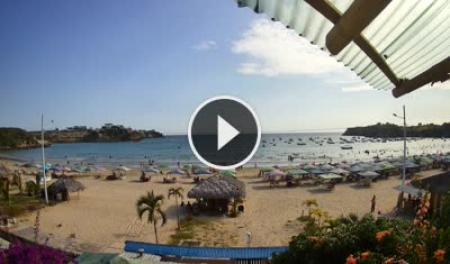
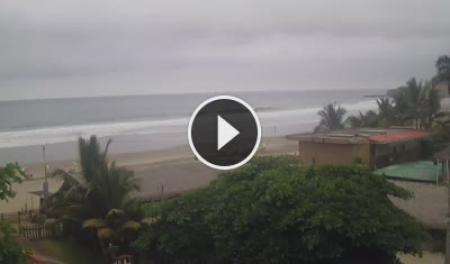
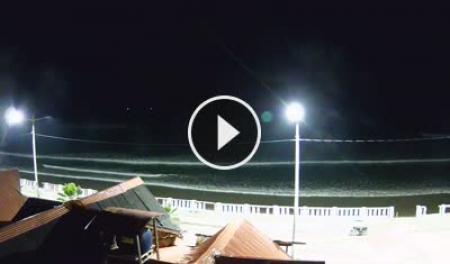
Live Beach Cams Current conditions along the route — images refresh automatically. Click any image to open the live feed.
Images refresh every few minutes on the SkylineWebcams servers. Cams run south to north in route order.
Starting from the Peninsula
The Ruta del Spondylus begins where the Santa Elena Peninsula ends. Frequent buses run north from La Libertad's Terminal Terrestre throughout the day, stopping at every town along the route. You can travel the full length in a single day, or base yourself in one town and explore on foot.
Geography & Landscape
The Spondylus Shell 3500 BC onwards
The Spondylus princeps — the thorny oyster — is harvested by coastal divers along this stretch of coast. It becomes the single most important trade item in pre-Columbian South America, exchanged from Ecuador to Chile and from the coast to the high Andes.
Ritual significance
Andean cultures — including the Inca — believed Spondylus had the power to bring rain. Its crimson interior color was associated with blood, sacrifice, and the sea goddess. Only nobility and priests could possess it.
The trade network
The coastal communities along this route were the source. Balsa-wood trading vessels — some large enough for 20 people — carried shells north and south. The Spanish conquistadors first encountered these boats off the coast of what is now Santa Elena Province.
Today
The shell gives its name to the modern highway, and local artisans still carve and sell Spondylus jewelry in Montañita and other market towns along the route. The diving tradition that started 5,000 years ago continues in Ayangue and Anconcito.
Nature & Ecology
Outdoor Activities Each activity links to its own page with spots, conditions, access, difficulty, and local operators.
Getting There & Around
|
|